History
Staff
Head of Department
Mrs C Bailie
Subject Teachers
Mrs C Murphy
Miss E Luke
Mr L McWatters Mr C Nicholson
Mr B Davison Mrs K Parkes
Aims
At Regent House, we aim to provide pupils with a wide range of transferable skills through studying events that happened in the past. We aim to develop:
• The ability to communicate both orally and in written form
• Problem solving and decision making through analysing evidence
• Management of information basing conclusions on research
• The ability to work with others through a range of activities
• Self management through the completion of short project work
Key Stage 3
History is studied from Years 8 - 10 during three periods per week.
Topics studied are as follows:
Year 8
What is History?
Events of 1066
Towns, villages and the Black Death
Medieval Castles
The Medieval Church
Normans in Ireland
The Emergence of Parliament
The Incan Empire
Medieval Mali
Year 9The Renaissance
Exploration, Colonisation and Empire
Transatlantic Slavery
The Reformation
Ireland 1540-1609: Plantation
The Enlightenment
The American Revolution
The Industrial Revolution
Ireland 1790-1850: Rebellion and Famine
Year 10
World War 1
Partition of Ireland
Post War Dictatorships
World War 2
Origins of the Cold War
International Institutions
American Civil Rights
Key Stage 4 History
Pupils follow the CCEA GCSE History specification.
The most important quality for historians to possess is an inquisitive mind and a desire to research and examine evidence. GCSE History will provide students with the opportunity to explore important periods from the 20th century that have shaped our world. Discussion in class will lead to the development of written communication skills.
The specification includes three Units.
Course content is as shown:
• Modern World Studies in depth
Life in Nazi Germany, 1933–45
Changing Relations: Northern Ireland and its Neighbours, 1965–98
• Outline study
International Relations, 1945–2003
Key Stage 4 Politics
Pupils will follow the CCEA GCSE Government and Politics specification which focuses on democracy and international politics. Students will develop their understanding of the political world.
Students consider different political parties’ policies, citizens’ rights and responsibilities, and the role of the media. They also explore organisations that operate globally and their responses to issues such as conflict resolution and migration. They gain insight into the political process and how government decisions affect us.
Students develop skills useful in any context, from analysing data and problem solving to taking part in debates and justifying their views.
Students who gain this qualification may be interested in careers in government, law, business, finance, research, journalism, the media, the charity sector, political research, political campaigning or public service. They may also progress to GCE AS or A Level in Government and Politics.
The specification has two units:
Unit 1: Democracy in Action - this will be assessed by external examination at the end of Year 11.
Unit 2; International Politics in Action - this will be assessed by external examination at the end of Year 12
A Level
The department offer two subjects at A Level: History and Government and Politics.
History
Government and Politics
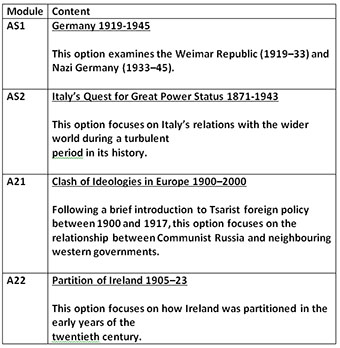
Pupils follow the CCEA GCE History specification. From September 2016, the options followed have been:
Pupils follow the CCEA GCE Government and Politics specification. The options followed are:


Careers
History and Government and Politics is a subject which is studied by pupils who wish to progress on to a wide variety of careers. The skills that are developed which include research skills, how to organise information, communication and writing skills, how to construct an argument and problem solving lend themselves to a wide variety of careers including:
Administration
Politics
Banking
Journalism
Law
Teaching
TV & Media
Very often, students who wish to pursue a career in the natural sciences also study Government and Politics as it develops the skills listed above.